
Pay Stub Abbreviations: Every Code on Your Paycheck Explained (2027)
Updated for 2027: figures on this page use the 2027 federal tax figures (IRS Revenue Procedure 2026-35, announced 5 November 2026).
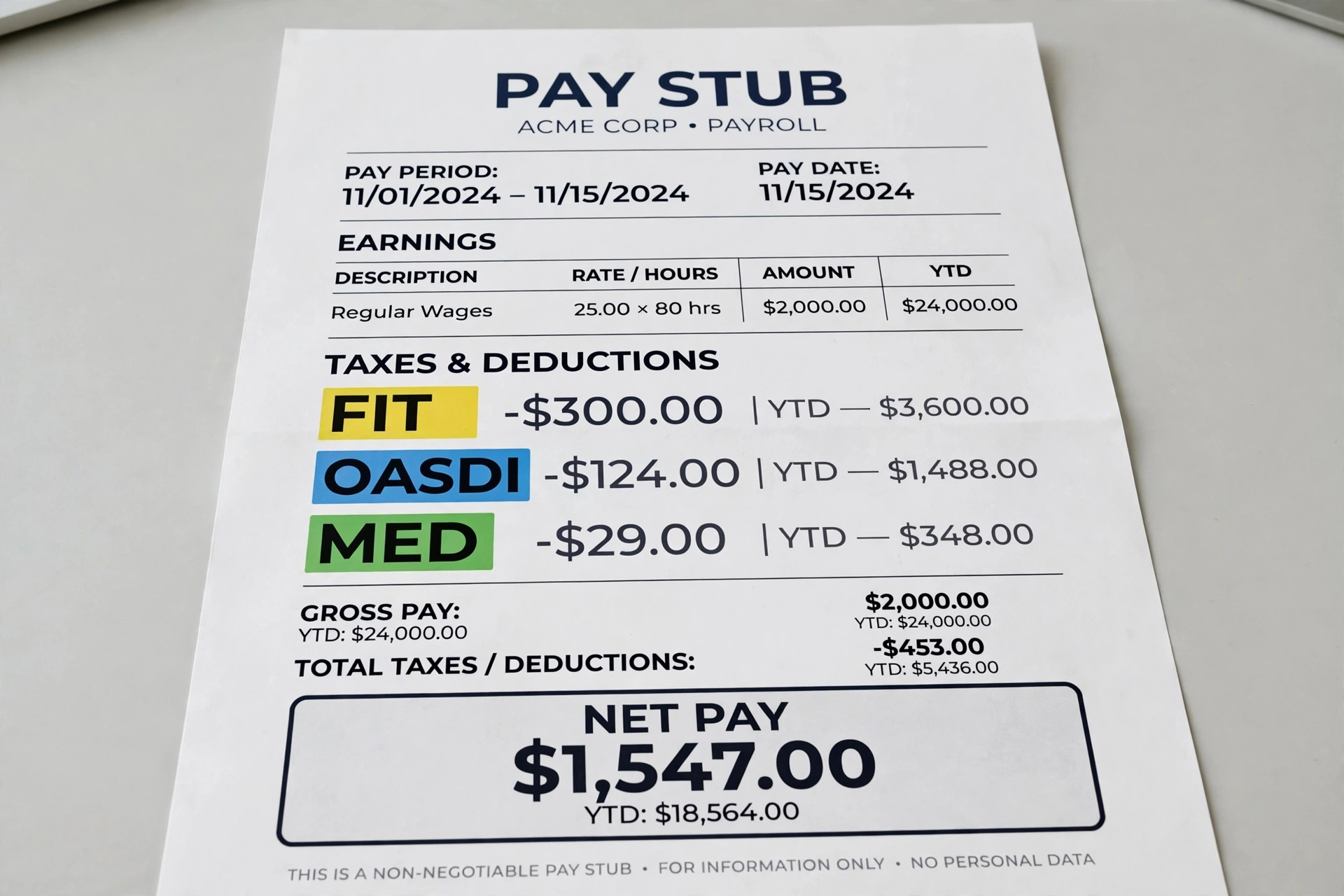
Pay stub abbreviations are the short codes your employer uses for every line on your paycheck: FIT is federal income tax, OASDI is Social Security, MED is Medicare, and YTD is your year-to-date total.
Pay stub abbreviations are the short codes your employer uses for every line on your paycheck: FIT is federal income tax, OASDI is Social Security, MED is Medicare, and YTD is your year-to-date total. Once you know the four groups these codes fall into — earnings, taxes, deductions, and totals — any stub takes about a minute to decode.
⚡ Key Takeaways
- Every pay stub code belongs to one of four groups: earnings (what you made), taxes (what government takes), deductions (benefits and other amounts you chose or owe), and totals (running sums like YTD).
- Tax codes are standardized by law: Social Security is 6.2% of wages up to $192,300 in 2027, Medicare is 1.45% on all wages, plus an extra 0.9% on wages over $200,000.
- Benefit codes (401K, HSA, DNTL) are not standardized — each employer names them differently, so the same deduction can appear under different codes at different jobs.
- Two codes should never be deducted from your pay: FUTA and the employer share of FICA — those are your employer's costs, not yours.
- You can verify any stub in 60 seconds: Social Security should equal exactly 6.2% of your gross pay, and Medicare exactly 1.45%.
What Do the Codes on a Pay Stub Mean?
Payroll systems process thousands of paychecks, so they compress every line into a 2–5 letter code. The codes look cryptic, but they follow a pattern — each one answers one of four questions:
- Earnings codes — how did I earn this money? (regular hours, overtime, PTO)
- Tax codes — which government is taking this, and for what? (federal, state, Social Security)
- Deduction codes — what benefit or obligation is this paying for? (retirement, health insurance)
- Total codes — what are the running sums? (gross, net, year-to-date)
The four tables below decode the codes you are most likely to see. If you want the bigger picture of how the boxes on a stub fit together, start with our guide on how to read your pay stub — this article is the dictionary to use alongside it.
Earnings Codes: How You Earned the Money
| Code | Stands for | What it means |
|---|---|---|
| REG | Regular pay | Your normal hours × your hourly rate (or your salary slice for the period) |
| OT | Overtime | Hours over 40 in a workweek, paid at 1.5× your regular rate |
| DT | Double time | Hours paid at 2× your rate (some employers/states, common on holidays) |
| PTO | Paid time off | Vacation or personal hours paid while you were away |
| VAC | Vacation | Vacation hours used (some employers split this from PTO) |
| SICK | Sick pay | Paid sick-leave hours |
| HOL | Holiday pay | Pay for a company holiday you didn't work |
| BONUS | Bonus | Performance, sign-on, referral or holiday bonus — taxed as supplemental wages |
| COMM | Commission | Sales commission earned this period |
| TIP | Tips | Reported tip income |
| RETRO | Retroactive pay | Back pay correcting an earlier period (e.g., a late-processed raise) |
Tax Codes: What Government Takes
| Code | Stands for | What it means in 2027 |
|---|---|---|
| FIT / FED / FWT | Federal income tax withheld | Based on your Form W-4 and the IRS withholding tables — an estimate, settled when you file |
| FICA | Federal Insurance Contributions Act | The umbrella label for Social Security + Medicare; some stubs show one FICA line, others split it |
| SS / OASDI / SOC SEC | Social Security tax | 6.2% of wages up to the 2027 wage base of $192,300 — stops once your YTD wages pass the cap |
| MED / HI / FICA-MED | Medicare tax | 1.45% of all wages, no cap |
| ADDL MED | Additional Medicare Tax | Extra 0.9% withheld once your YTD wages pass $200,000 (employee only, never matched) |
| SIT / SWT / ST TAX | State income tax withheld | Your state's income tax — missing entirely in the 9 states with no wage tax (TX, FL, NV, WA, etc.) |
| LIT / LOCAL / CITY | Local income tax | City/county tax where it applies (parts of OH, PA, IN, MD, NY and others) |
| SDI / CASDI / TDI | State disability insurance | Employee-paid disability insurance in CA, NJ, NY, RI and HI |
| PFL / PFML | Paid family & medical leave | Employee contributions in states like CA, NY, NJ, WA, MA, CT, OR, CO |
| SUI / SUTA | State unemployment insurance | Almost always employer-paid — employees contribute only in AK, NJ and PA |
Deduction Codes: Benefits and Other Amounts
| Code | Stands for | Pre-tax or post-tax? |
|---|---|---|
| 401K / 403B / 457 | Retirement contribution | Pre-tax (traditional) — lowers your taxable income now |
| ROTH | Roth 401(k)/403(b) contribution | Post-tax — no tax break now, tax-free in retirement |
| HSA | Health savings account | Pre-tax — requires a high-deductible health plan |
| FSA | Flexible spending account | Pre-tax — mostly "use it or lose it" each year |
| SEC 125 | Section 125 cafeteria plan | Pre-tax premiums (health, dental, vision) run through this plan |
| DNTL / DENT | Dental insurance premium | Usually pre-tax via Section 125 |
| VIS | Vision insurance premium | Usually pre-tax via Section 125 |
| MED INS / HLTH | Medical insurance premium | Usually pre-tax via Section 125 |
| STD / LTD | Short-term / long-term disability premium | Often post-tax, so any future benefit arrives tax-free |
| LIFE / GTL | Life insurance / group term life | Premium for coverage over $50,000 shows up as taxable imputed income |
| IMP / IMPUTED | Imputed income | Taxable value of a benefit (like extra life insurance) — taxed, but not paid to you in cash |
| GARN / LEVY | Garnishment or tax levy | Court-ordered or IRS-ordered deduction (child support, debts, back taxes) |
| UNION | Union dues | Post-tax |
| PARK | Parking / transit benefit | Often pre-tax up to IRS limits |
Total Codes: The Running Sums
| Code | Stands for | What it means |
|---|---|---|
| GROSS | Gross pay | Total earnings before anything is taken out |
| NET | Net pay | What actually lands in your bank account |
| CUR / THIS PERIOD | Current period | The amount for this paycheck only |
| YTD | Year-to-date | The running total from January 1 through this check — the column that matters at tax time |
| EE / ER | Employee / Employer | Splits a cost between your share (EE) and your employer's share (ER) when both are shown |
| TXBL / TAXABLE | Taxable wages | The portion of pay a given tax applies to (lower than gross if you have pre-tax deductions) |
Here is a biweekly stub for a $75,000 salary, with the codes translated:
- REG — $2,884.62: $75,000 ÷ 26 biweekly periods
- FIT — $284.21: federal withholding per the employee's W-4
- OASDI — $178.85: 6.2% × $2,884.62 (Social Security)
- MED — $41.83: 1.45% × $2,884.62 (Medicare)
- SIT — $115.00: state income tax (amount varies by state; $0 in Texas or Florida)
- 401K — $144.23: 5% pre-tax retirement contribution
- SEC 125 — $85.00: pre-tax health insurance premium
- NET — $2,035.50: $2,884.62 − $284.21 − $178.85 − $41.83 − $115.00 − $144.23 − $85.00
And the YTD column tells the longer story: after 10 pay periods this employee's YTD gross is $28,846.20 and YTD Social Security is about $1,788.50 — numbers that should match the W-2 they receive in January. To see the same math run on your own salary and state, try the Paycheck Calculator.
How Can You Check Your Stub's Math in 60 Seconds?
You don't need to decode every line to catch the most expensive errors. Three checks cover most problems:
- Social Security check: multiply your gross pay by 0.062. The OASDI/SS line should match within a few cents. If it doesn't, something is wrong.
- Medicare check: multiply gross by 0.0145 — that should equal the MED line exactly (until the $200,000 Additional Medicare threshold).
- The cap check: once your YTD wages pass $192,300, the Social Security line should drop to $0 for the rest of the year. If it keeps deducting, you're overpaying — and payroll can fix it.
Then scan for the two human errors no formula catches: the wrong state code (common for remote workers) and a deduction you never signed up for. Required taxes need no permission, but voluntary deductions do — an unfamiliar code you never authorized is worth an immediate question to payroll. Our full walkthrough of how take-home pay is calculated shows where each of these lines comes from.
Which Codes Should Never Come Out of Your Pay?
Two items appear on some stubs for information only but must never reduce your net pay:
- FUTA (federal unemployment tax) — paid entirely by your employer. It should never appear among your deductions.
- The employer share of FICA — your employer matches your 6.2% + 1.45% out of their own pocket. If a stub shows an "ER" (employer) column, those amounts are informational; only the "EE" (employee) share comes out of your check.
If either is being deducted from your wages, take the stub to payroll — that's a genuine error, not a policy choice.
Frequently Asked Questions
What does OASDI mean on a pay stub?
OASDI stands for Old-Age, Survivors, and Disability Insurance — the official name of the Social Security tax. It is withheld at 6.2% of your wages up to $192,300 in 2027 and may also appear on your stub as SS, SOC SEC, or as part of a combined FICA line.
What is the difference between FIT and FICA?
FIT is your federal income tax — it varies with your income, filing status, and W-4, and it's an estimate settled when you file your return. FICA is the fixed payroll tax for Social Security (6.2%) and Medicare (1.45%) — the same rates for almost every employee, with no W-4 control over them.
Why does my pay stub show two Medicare lines?
The second line is usually ADDL MED — the 0.9% Additional Medicare Tax your employer must withhold once your year-to-date wages pass $200,000. Only you pay it (your employer doesn't match it), and your final liability is reconciled on your tax return, since it depends on your total household income and filing status.
What does GTL or "imputed income" mean — why am I taxed on money I never received?
If your employer pays for group term life insurance above $50,000 of coverage, the IRS treats the value of that extra coverage as taxable income. It appears as GTL or imputed income: it raises the wages your taxes are calculated on, but no cash changes hands — so your tax lines go up slightly while your gross cash pay doesn't.
Why does my coworker's stub use different codes than mine?
For tax lines, the codes are effectively standard because the taxes are set by law. For benefit lines, there is no national standard — each payroll system and employer names deductions its own way, so your 401(k) might be "401K" at one job and "RETIRE" at the next. If a code is unfamiliar, payroll can always tell you exactly what it maps to.
Try It Yourself
Want to see a clean stub with every line labeled clearly? Use our free Pay Stub Generator — enter your pay details and it builds a professional pay stub with every box filled in. To estimate the bottom line for any salary and state, try the Paycheck Calculator.