
How to Calculate Take-Home Pay in 2027 (Step-by-Step)
Updated for 2027: figures on this page use the 2027 federal tax figures (IRS Revenue Procedure 2026-35, announced 5 November 2026).
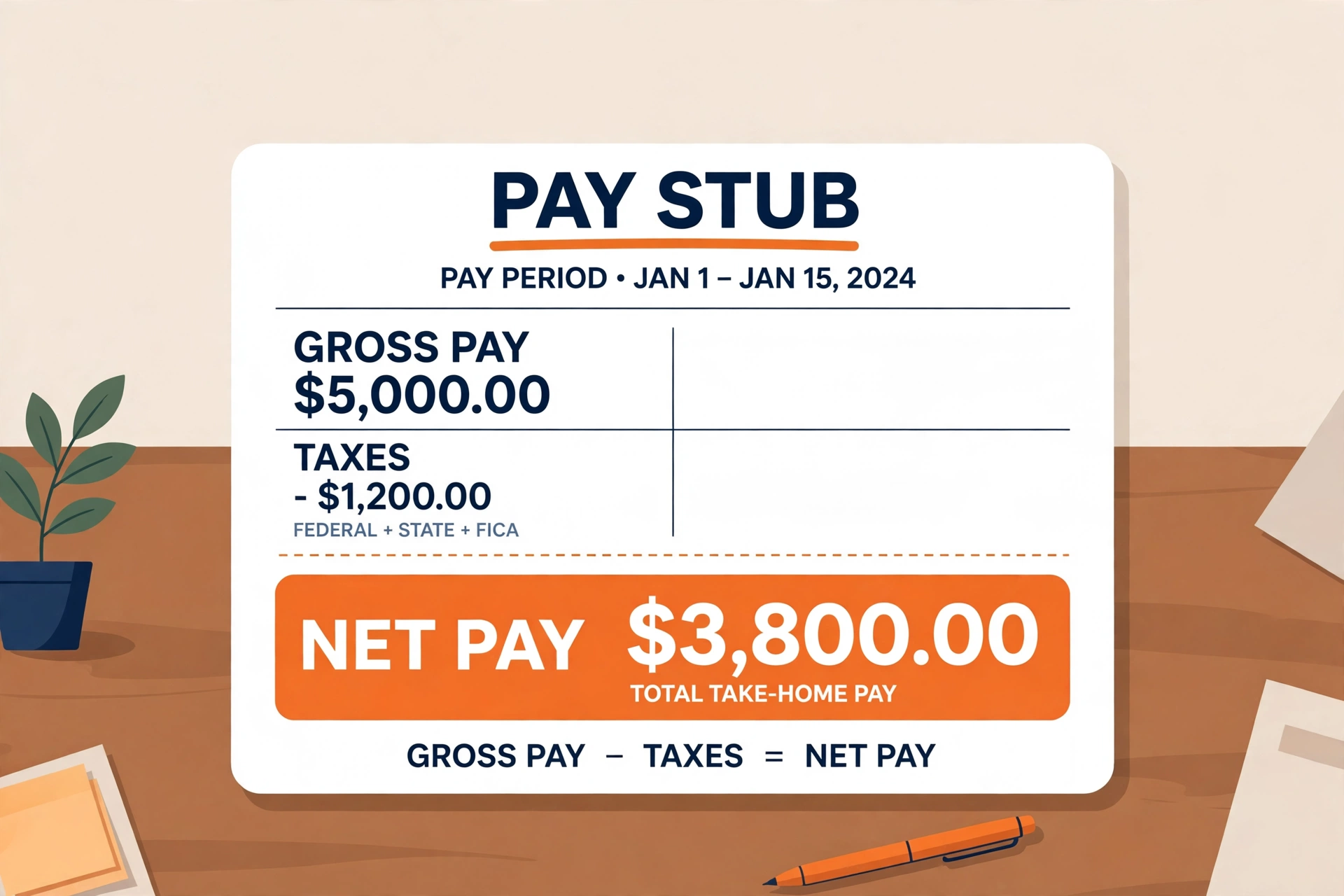
Your take-home pay — also called net pay — is your gross pay minus federal income tax, FICA taxes, state and local taxes, and any pre-tax deductions. For example, a single filer earning $75,000 in a state with no income tax takes home about $61,873.00 per year, or $2,379.73 every two weeks.
Your take-home pay — also called net pay — is your gross pay minus federal income tax, FICA taxes, state and local taxes, and any pre-tax deductions. For example, a single filer earning $75,000 in a state with no income tax takes home about $61,873.00 per year, or $2,379.73 every two weeks. This guide walks through the exact steps so you can do the math yourself.
⚡ Key Takeaways
- Take-home pay = gross pay − federal income tax − FICA − state/local taxes − pre-tax deductions.
- For 2027, federal income tax brackets run from 10% to 37%, and the single standard deduction is $16,600.
- FICA taxes are 6.2% for Social Security (on wages up to $192,300) plus 1.45% for Medicare on all wages.
- Your pay frequency changes the per-check amount, not your annual take-home total.
- The steps below show the math; a calculator gives you the answer in seconds.
What Is Take-Home Pay?
Gross pay is the full salary or wage your employer agrees to pay you. Take-home pay is what actually lands in your bank account after every required withholding and deduction. The gap between the two surprises a lot of people — a $75,000 salary does not mean $75,000 of spending money.
Understanding the calculation matters because it affects real decisions: comparing job offers in different states, setting a budget, or deciding how much to contribute to a retirement plan. Once you know the steps, you can estimate your net pay for any salary.
Step 1: How Much Federal Income Tax Comes Out?
Federal income tax uses a marginal bracket system, which means different chunks of your income are taxed at different rates. For 2027, the single-filer brackets are:
| Tax rate | Taxable income (single) |
|---|---|
| 10% | $0 – $12,800 |
| 12% | $12,801 – $52,025 |
| 22% | $52,026 – $109,125 |
| 24% | $109,126 – $208,325 |
| 32% | $208,326 – $264,550 |
| 35% | $264,551 – $661,375 |
| 37% | $661,376 and up |
Before applying these rates, subtract the standard deduction from your gross pay. For 2027, the standard deduction is $16,600 for single filers, $33,200 for married couples filing jointly, and $24,925 for heads of household. Most people take the standard deduction rather than itemizing.
A common mistake is thinking your whole income gets taxed at your top bracket rate. It does not. If your taxable income is $58,400, only the dollars above $52,025 are taxed at 22% — everything below that is taxed at 10% and 12%.
Step 2: What Are FICA Taxes and How Much Are They?
FICA (the Federal Insurance Contributions Act) funds Social Security and Medicare, and it applies to almost all wage earners. For 2027:
- Social Security: 6.2% on wages up to $192,300. Earnings above that cap are not subject to Social Security tax.
- Medicare: 1.45% on all wages, with no cap. Single filers earning over $200,000 pay an additional 0.9% Medicare surtax on wages above that threshold.
Your employer withholds your share automatically and matches the Social Security and base Medicare amounts out of its own pocket. Unlike federal income tax, there is no standard deduction for FICA — it applies from the first dollar of wages.
Step 3: How Do State and Local Taxes Affect Take-Home Pay?
State and local taxes vary widely. Some states, like Florida and Texas, have no personal income tax at all. Others, like California and New York, have their own graduated bracket systems. A few cities and counties add local income taxes on top.
This step is where two identical salaries can produce very different take-home pay. Always check the rules for the state where you work, not just where you live, since withholding is generally based on your work location.
Step 4: What Are Pre-Tax Deductions?
Pre-tax deductions come out of your paycheck before income tax is calculated, which lowers both your taxable income and your take-home pay. Common examples include 401(k) contributions, health insurance premiums, and HSA contributions.
These deductions reduce your current tax bill, but they also reduce the amount deposited into your checking account each payday. When estimating take-home pay, list every deduction on your pay stub so nothing is missed.
Step 5: How Do I Figure Out My Per-Paycheck Amount?
Once you have your annual take-home figure, divide it by the number of paychecks per year:
- Weekly: divide by 52
- Biweekly (every two weeks): divide by 26
- Semimonthly (twice a month): divide by 24
- Monthly: divide by 12
Pay frequency does not change your annual total. A biweekly schedule simply slices the same yearly amount into 26 pieces.
Let's calculate take-home pay for a single filer earning $75,000 with no state income tax and no pre-tax deductions.
1. Taxable income: $75,000 − $16,600 (standard deduction) = $58,400
2. Federal income tax:
- 10% × $12,800 = $1,280.00
- 12% × $39,225 = $4,707.00
- 22% × $6,375 = $1,402.50
- Total federal tax = $7,389.50
3. FICA taxes:
- Social Security: 6.2% × $75,000 = $4,650.00
- Medicare: 1.45% × $75,000 = $1,087.50
- Total FICA = $5,737.50
4. State tax: $0.00
5. Annual take-home pay: $75,000 − $7,389.50 − $5,737.50 = $61,873.00
6. Biweekly paycheck: $61,873.00 ÷ 26 = $2,379.73
Frequently Asked Questions
Why is my take-home pay less than my salary divided by 26?
Because federal income tax, Social Security, and Medicare are withheld before you are paid. A $75,000 salary divided by 26 is $2,884.62, but after $7,389.50 in federal tax and $5,737.50 in FICA, each biweekly check is $2,379.73.
What is the difference between gross pay and net pay?
Gross pay is your total earnings before any deductions. Net pay — take-home pay — is what remains after taxes and deductions. Your pay stub shows both figures side by side.
Do pre-tax deductions increase or decrease my take-home pay?
They decrease the amount of each paycheck, because the money goes to your 401(k) or insurance premium instead of your bank account. The trade-off is that they also lower your taxable income, so you owe less income tax.
How can I increase my take-home pay without a raise?
The main lever is your Form W-4 withholding. If too much federal tax is withheld, you get a big refund but smaller paychecks; adjusting your W-4 can shift that balance. Note that this changes timing, not your total annual tax.
Is take-home pay the same as taxable income?
No. Taxable income is gross pay minus deductions like the standard deduction, and it determines your income tax. Take-home pay subtracts the actual taxes plus FICA and other deductions. In our example, taxable income was $58,400 while take-home pay was $61,873.00.
Try It Yourself
Want the number without doing the math by hand? Use our free Take-Home Pay Calculator — enter your salary, filing status, and state to see your estimated per-paycheck amount instantly.