
How to Read Your Pay Stub: Every Box Explained (2027)
Updated for 2027: figures on this page use the 2027 federal tax figures (IRS Revenue Procedure 2026-35, announced 5 November 2026).
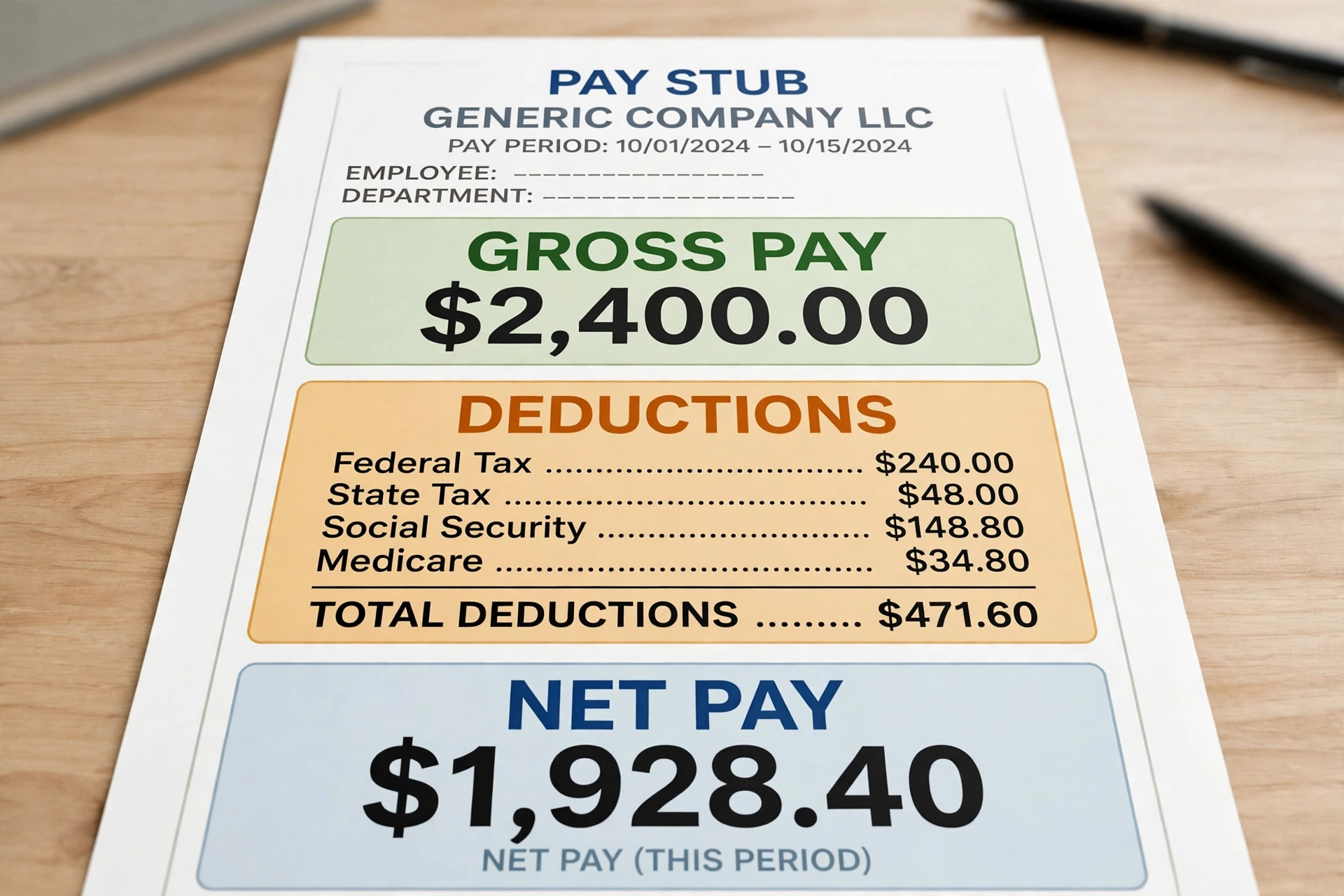
Your pay stub is the receipt for every paycheck — it shows exactly where your gross pay goes before the net amount lands in your bank account. Most people glance at the bottom-line number and never decode the middle.
Your pay stub is the receipt for every paycheck — it shows exactly where your gross pay goes before the net amount lands in your bank account. Most people glance at the bottom-line number and never decode the middle. This guide walks through every box on a typical US pay stub, what each abbreviation means, and how the numbers connect — using a real worked example so you can follow along with your own stub.
⚡ Key Takeaways
- A pay stub has three layers: gross pay (what you earned), deductions (taxes and benefits), and net pay (what you keep).
- Federal income tax withholding follows your W-4; FICA is fixed — 6.2% Social Security (on wages up to $192,300 in 2027) plus 1.45% Medicare on all wages.
- YTD (year-to-date) columns let you spot payroll errors early — compare them against your expected gross.
- Pre-tax deductions (401(k), health premiums) lower your taxable income; post-tax deductions (Roth 401(k), garnishments) don't.
- Found a mistake? Tell your employer's payroll department first — payroll errors are common and usually fixable.
The Three Layers of Your Pay Stub
Think of a pay stub as a simple equation:
Gross pay − Deductions = Net pay
At the top of the stub you'll find identifying information: your name, employee ID, the employer's name, the pay period (the dates the work covered) and the pay date (when the money was deposited). Always check these first — a wrong pay period is the most common source of confusion when a check looks "off."
The pay frequency also matters for the math: weekly (52 checks/year), biweekly (26), semimonthly (24), or monthly (12). Two people earning the same salary can have very different per-check amounts just because one is paid biweekly and the other semimonthly.
Box 1: Gross Pay — What You Earned
Gross pay is your total earnings before anything is taken out. On a stub it's usually broken into lines like:
- Regular earnings: hours worked × hourly rate (e.g., 80 hours × ~$36.06/hr ≈ $2,884.62)
- Overtime: overtime hours × overtime rate, typically 1.5× your regular rate
- Bonuses, commissions, PTO payout: any extra pay this period
If you are salaried, the regular earnings line is simply your annual salary divided by the number of pay periods — for a $75,000 salary paid biweekly, that's $2,884.62 every check.
Box 2: Federal Income Tax Withholding
This line (often labeled "Fed W/H" or "Federal Withholding") is the federal income tax your employer withholds based on your Form W-4 and the 2027 brackets. For 2027 the brackets run 10%–37%, and the single-filer standard deduction is $16,600.
Unlike FICA, this amount is an estimate — your employer withholds what the IRS tables say, but the final bill is settled when you file your return. That's why getting a refund (or owing money) at tax time doesn't mean your employer made a mistake; it means the estimate differed from your actual tax.
Box 3: State and Local Income Tax
If you work in a state with income tax (California, New York, and most others), a separate line withholds it. Rates and rules vary widely by state — a few states, like Texas and Florida, have no state income tax at all, so this line may be missing or $0.00.
Local taxes (city or county, e.g., in parts of Ohio or Pennsylvania) appear on a separate line when they apply. If you moved or work in multiple states during the year, check that the state listed matches where you actually earned the wages — a wrong state code is a classic payroll error.
Box 4: FICA — Social Security and Medicare
FICA (Federal Insurance Contributions Act) taxes are the one part of the stub that is identical for every employee, because the rates are fixed by law:
- Social Security ("SS" or "OASDI"): 6.2% of wages up to the 2027 wage base of $192,300. Above that cap, no more Social Security tax is withheld for the year.
- Medicare ("Med"): 1.45% on all wages, with no cap.
- Additional Medicare Tax: an extra 0.9% on wages above $200,000 (single) / $250,000 (married filing jointly).
Combined, most employees pay 7.65% of each paycheck in FICA — and your employer matches that amount behind the scenes. You can't adjust FICA the way you can adjust income-tax withholding with a W-4; it's not optional.
Box 5: Pre-Tax Deductions
These reduce your taxable income — the money is set aside before income tax is calculated, so you owe less tax on what's left:
- 401(k) / 403(b) retirement contributions (traditional, not Roth)
- Health, dental, and vision insurance premiums
- HSA (Health Savings Account) and FSA (Flexible Spending Account) contributions
- Commuter / transit benefits
Example: if your gross pay is $2,884.62 and you contribute $200 to a 401(k), your taxable wages drop to $2,684.62. You still "spent" the $200 — but it went to your retirement, not to the IRS.
Box 6: Post-Tax Deductions
These come out after taxes are calculated, so they don't lower your taxable income:
- Roth 401(k) contributions (taxed now, tax-free in retirement)
- Disability or life insurance premiums paid through payroll
- Union dues
- Wage garnishments (court-ordered — child support, back taxes, debts)
If a deduction you don't recognize appears here, ask payroll about it. A new post-tax line that appeared without explanation is worth one email.
Box 7: Employer Contributions (Informational Only)
Many stubs list what your employer pays on your behalf — the employer match on your 401(k), the employer's share of your health premiums, and the employer's 7.65% FICA match. These are informational: they aren't deducted from your pay, but they show part of your real total compensation. A stub without them can make a job offer look worse than it is.
Box 8: YTD — Year-to-Date Totals
The YTD column accumulates every figure from January 1 through the current pay period. This is your best tool for catching errors:
- Gross YTD should equal (per-check gross) × (number of checks so far). Ten biweekly checks at $2,884.62 = $28,846.20.
- FICA YTD should track at 7.65% of gross YTD — a sudden jump or flatline can signal a wage-base or rate error.
- 401(k) YTD matters because there are annual contribution limits; the YTD total tells you how close you are.
Compare your YTD totals to your own math once a quarter. It takes five minutes and it's how most payroll mistakes get found.
Box 9: Net Pay — What Lands in Your Account
Net pay (also called take-home pay) is gross pay minus every deduction above. It's the number that hits your bank account — and it's almost always less than salary ÷ 26, which is where the confusion in Quora answers and Reddit threads usually starts.
Our $75,000 example, single filer, no state income tax, no pre-tax deductions:
- Gross biweekly pay: $75,000 ÷ 26 = $2,884.62
- Federal income tax: $7,389.50/year ÷ 26 = $284.21
- FICA: $5,737.50/year ÷ 26 = $220.67
- Net biweekly pay: $61,873.00 a year ÷ 26 = $2,379.73
That $504.89 gap between gross and net is the whole story of a pay stub in one check: income tax plus FICA, with state tax and benefit deductions layered on for most workers.
What To Do If Something Looks Wrong
- Recheck the pay period and frequency first — most "errors" are just a shorter period or an extra check that month.
- Run the FICA math yourself — 6.2% Social Security + 1.45% Medicare on gross should match within a few cents.
- Ask payroll, not your manager — payroll departments expect these questions and can reissue corrected stubs.
- Keep your stubs — lenders, landlords, and the IRS all accept pay stubs as income proof.
Frequently Asked Questions
What does YTD mean on a pay stub?
YTD stands for year-to-date — the running total of each line (gross pay, each tax, each deduction) from January 1 through the current pay period. Use it to verify your employer is withholding consistently and to track progress toward annual 401(k) limits.
Why is my net pay less than my salary divided by 26?
Because federal income tax, Social Security (6.2%), and Medicare (1.45%) are withheld before you are paid, plus any state tax and benefit deductions. A $75,000 salary is $2,884.62 per biweekly check gross, but after $284.21 federal tax and $220.67 FICA, net pay is $2,379.73 — before any state tax or 401(k).
What is the difference between pre-tax and post-tax deductions?
Pre-tax deductions (traditional 401(k), health premiums, HSA) are subtracted before income tax is calculated, lowering your taxable income. Post-tax deductions (Roth 401(k), union dues, garnishments) come out after taxes and don't reduce your tax bill.
Can my employer take money out of my paycheck without telling me?
Required withholdings (income tax, FICA) need no separate permission. Voluntary deductions (benefits, retirement) require your authorization — usually the forms you signed during onboarding. Garnishments require a court order. If a deduction appears that you never authorized, ask payroll immediately.
How do I get a copy of an old pay stub?
Ask your employer's payroll or HR department — most keep several years of records, and many payroll portals (ADP, Workday, Paychex) let you download old stubs yourself. Keep at least the last three years; lenders and the IRS may ask for them.
What should I check first when a paycheck looks wrong?
The pay period dates and your pay frequency. A check covering fewer days than usual, or a semimonthly schedule after a biweekly one, explains most surprises. Next, verify FICA: Social Security should be exactly 6.2% of gross (up to the $192,300 wage base) and Medicare exactly 1.45%.
Try It Yourself
Want to see what your stub should look like? Use our free Pay Stub Generator — enter your pay details and it builds a professional pay stub with every box filled in. To estimate the bottom line for any salary and state, try the Paycheck Calculator.