
How to Fill Out a W-4: Step-by-Step Guide for 2027
Updated for 2027: figures on this page use the 2027 federal tax figures (IRS Revenue Procedure 2026-35, announced 5 November 2026).
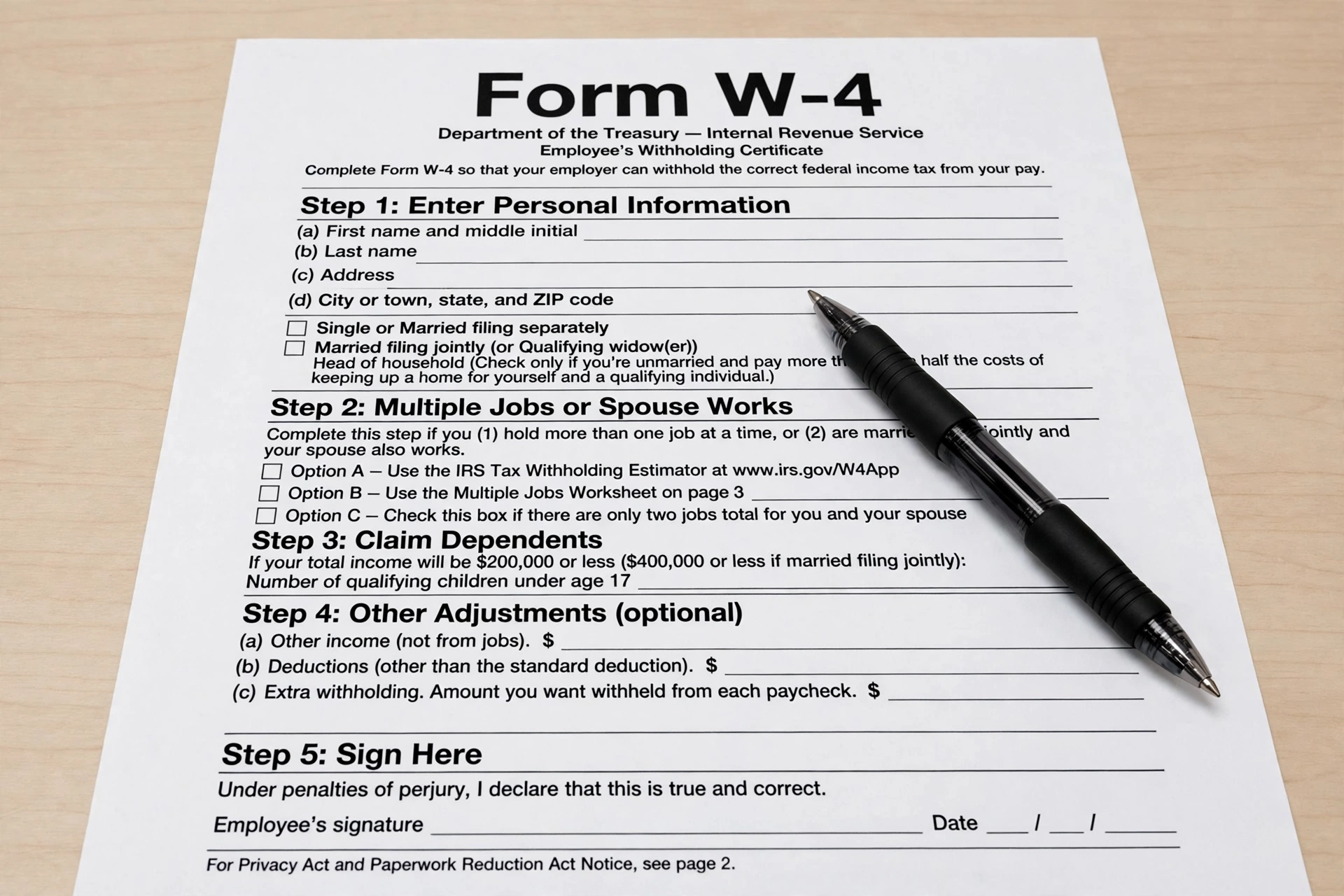
To fill out a W-4, complete Step 1 (your name, Social Security number, and filing status) and Step 5 (sign and date) — those two are mandatory for everyone. Steps 2–4 are only for people with multiple jobs, dependents, or other income or deductions.
To fill out a W-4, complete Step 1 (your name, Social Security number, and filing status) and Step 5 (sign and date) — those two are mandatory for everyone. Steps 2–4 are only for people with multiple jobs, dependents, or other income or deductions. The form takes about 10 minutes, and what you write on it decides how much tax comes out of every paycheck.
⚡ Key Takeaways
- The W-4 has 5 steps, but most people with one job and no dependents only need Steps 1 and 5.
- There are no more "allowances" — the form was redesigned in 2020. Anyone telling you to "claim 0 or 1" is using the old form's language.
- Step 3 (dependents) is the biggest paycheck lever: each qualifying child you enter reduces your annual withholding by $2,000 — about $76.92 more per biweekly paycheck.
- You can file a new W-4 at any time — after a marriage, a baby, a second job, or a too-big (or too-small) tax refund.
- Your W-4 goes to your employer, not the IRS. Your employer uses it to calculate withholding and keeps it on file.
What Is a W-4, and Why Does It Decide Your Paycheck Size?
Form W-4 (Employee's Withholding Certificate) is the form you hand your employer so they know how much federal income tax to withhold from each paycheck. Your employer doesn't guess — they run your pay through IRS tables using exactly what you put on this form.
That makes the W-4 a dial, not a formality:
- Withhold too much → smaller paychecks all year, then a big refund (an interest-free loan to the government).
- Withhold too little → bigger paychecks now, then a tax bill — possibly with a penalty — in April.
Try It Yourself
The form itself doesn't change your actual tax bill for the year; it only changes the timing of when the money leaves your paycheck. Our take-home pay calculator shows the end result for your salary and state.
Before You Start: What Do You Need?
- Your Social Security number and legal name, exactly as they appear on your Social Security card
- Your expected filing status (single, married filing jointly, or head of household)
- If you have a second job or a working spouse: a recent pay stub from each job (for Step 2)
- If you have dependents: their ages (the child credit amounts depend on age)
- For precision, the IRS Tax Withholding Estimator on irs.gov gives you exact figures to copy into Steps 2–4 — worth the 10 minutes if your situation isn't simple
How Do You Fill Out a W-4? (The 5 Steps)
Step 1: Enter Your Personal Information
Your name, address, Social Security number, and filing status — check one box: Single or Married filing separately, Married filing jointly (or qualifying surviving spouse), or Head of household.
This step matters more than it looks: your filing status sets the standard deduction your withholding is built around — $16,600 for single filers in 2027, double that ($33,200) for married filing jointly. Pick the status you'll actually use on your tax return.
Step 2: Multiple Jobs or Spouse Works
Complete this step only if you hold more than one job at the same time, or you're married filing jointly and your spouse also works. Without it, two-job households systematically under-withhold, because each employer withholds as if theirs were your only income.
You have three options, from most to least precise:
- Use the IRS Tax Withholding Estimator online — it tells you the exact amount to put in Step 4(c).
- Use the Multiple Jobs Worksheet on page 3 of the form and enter the result in Step 4(c).
- Check the box in Step 2(c) — simplest, but only accurate if the two jobs pay roughly similar amounts. Check it on both jobs' W-4s.
Complete Steps 2–4 on the W-4 for your highest-paying job only; leave them blank on the other jobs' forms.
Step 3: Claim Dependents
If your total income will be $200,000 or less ($400,000 or less if married filing jointly), you can claim the child tax credit and dependent credits here — this is what reduces your withholding:
- Multiply the number of qualifying children under age 17 by $2,300
- Multiply the number of other dependents by $500
- Add them together and enter the total
If your income is above those limits, skip this step — you'll settle the credits on your tax return instead.
Note: the IRS has only published a draft 2027 Form W-4 so far, and its Step 3 amount is still a placeholder — $2,300 is the 2027 child tax credit amount (IRS Rev. Proc. 2026-35), the figure Step 3 has tracked in the 2025 ($2,000) and 2026 ($2,200) forms. Confirm it against the final 2027 form when the IRS publishes it.
Step 4: Other Adjustments (Optional)
Three lines, all optional:
- 4(a) — Other income: income not from a job (interest, dividends, retirement income) that you want withholding to cover. Entering it raises your withholding so you don't owe it all in April.
- 4(b) — Deductions: if you itemize or expect deductions beyond the standard deduction, the Deductions Worksheet on page 3 converts them into a lower withholding amount.
- 4(c) — Extra withholding: any extra amount you want taken out of every paycheck. This is the simplest dial of all — freelancers with side income often use it (e.g., enter $50 and exactly $50 more is withheld per check).
Step 5: Sign and Date
Sign and date the form. An unsigned W-4 is not valid — your employer will withhold as if you were single with no other entries, which usually means too much withheld. Give the completed form to your employer (HR or payroll); do not mail it to the IRS.
Take an employee earning $60,000, paid biweekly:
- Step 1 only (single, one job, no dependents): withholding follows the standard tables — the baseline.
- Add two kids in Step 3: 2 × $2,300 = $4,600 entered. Withholding drops by roughly $4,600 spread over the year — about $176.92 more in each biweekly paycheck. The money arrives in their paychecks instead of coming back as a refund.
- Add $50 in Step 4(c) (say, to cover a spouse's side-gig income): exactly $50 less per paycheck — a deliberate trade of paycheck size now for no tax bill later.
Same salary, same job — three noticeably different paychecks, all decided by this one page. To see your own number before you file the form, run your salary through the Paycheck Calculator and compare it with your current stub.
When Should You File a New W-4?
Your W-4 doesn't expire, but your life changes. File a fresh one whenever you:
- Get married or divorced (your filing status changed)
- Have or adopt a child (Step 3 just became worth real money)
- Start or lose a second job — or your spouse starts or stops working (Step 2)
- Get a large refund or a large tax bill two years in a row — your withholding is miscalibrated
- Buy a home or start itemizing deductions (Step 4(b))
A new W-4 must take effect by the first payroll period ending on or after 30 days from when you hand it in — most employers apply it within one or two pay cycles. New hires must have one on file before their first paycheck; if you don't submit one, you're withheld at the single-filer default.
What Are the Most Common W-4 Mistakes?
- Both spouses claiming the same dependents. Claim each dependent on one W-4 only — claiming them twice under-withholds all year.
- Forgetting a second job. Each employer withholds as if it's your only income; two jobs without Step 2 almost always means a bill in April.
- Claiming "exempt" when you don't qualify. You can claim exempt only if you had no tax liability last year and expect none this year — and you must file a new W-4 by February 15 every year to keep the status. Claiming it wrongly means penalties.
- Never updating it. A W-4 from your first job, pre-marriage and pre-kids, is quietly costing you paycheck money every single period.
- Confusing the W-4 with the W-2. The W-4 is the instruction sheet you give your employer; the W-2 is the year-end statement your employer gives you (and the IRS). You never send a W-4 to the IRS.
For the full picture of how withholding fits into your pay, see our guide on how federal income tax is figured on a paycheck.
Frequently Asked Questions
Do I send my W-4 to the IRS?
No. You give it to your employer, who uses it to calculate your withholding and keeps it on file. The IRS only sees it if they specifically request it from your employer during a review — which is rare.
How many allowances should I claim on my W-4?
None — allowances no longer exist. The redesigned (2020 and later) W-4 removed them entirely and replaced them with the five steps. If a form or a coworker mentions allowances, it's the old pre-2020 version; the current form asks for dollar amounts and checkboxes instead.
Can I claim exempt from withholding on a W-4?
Yes, if you meet both conditions: you had no federal tax liability last year (and received a refund of all withholding), and you expect none this year. Write "Exempt" in the space below Step 4(c), complete only Steps 1 and 5, and file a new W-4 by February 15 each year to keep the status. Most full-time employees do not qualify.
How often can I change my W-4?
As often as you like. There's no limit and no waiting period — submit a new form to your employer whenever your situation changes, and they must apply it within about 30 days. Many employees adjust theirs once a year after seeing their tax refund or bill.
What happens if I fill out my W-4 wrong?
Nothing catastrophic — and it's fully fixable. Too much withholding just means a bigger refund; too little means a balance due (with a possible underpayment penalty if the gap is large). Either way, file a corrected W-4 as soon as you notice, and the fix applies to your future paychecks. Our explanation of how take-home pay is calculated can help you spot the mismatch.
Try It Yourself
Want to see the paycheck before you commit to the form? The free Take-Home Pay Calculator shows what your salary leaves you after federal and state taxes — compare it against your current stub to see if your W-4 needs an update.